
In today’s digital economy, the ability to harness data effectively often defines whether an organization thrives or struggles. Businesses are generating more information than ever before—every click, transaction, interaction, and sensor reading adds to the growing ocean of data. While traditional databases and warehouses have served organizations well for decades, the scale, diversity, and velocity of modern data call for something more adaptive and scalable.
Enter the Data Lake—a flexible, powerful, and forward-looking approach to data storage and analytics. Unlike rigid, schema-bound databases, data lakes embrace raw, unstructured, semi-structured, and structured data in a single repository, making them a cornerstone of enterprise analytics, artificial intelligence (AI), and digital transformation strategies.
This article dives deep into the concept of data lakes, their architecture, business value, challenges, governance considerations, and future trends—giving you consulting-grade insight into why data lakes are not just another buzzword but a foundation for tomorrow’s data-driven enterprises.
What is a Data Lake?
A Data Lake is a centralized storage repository that allows you to store all types of data—structured, semi-structured, and unstructured—at any scale. Unlike traditional relational databases or data warehouses that require data to be cleaned and modeled before storage, data lakes allow organizations to store data in its raw, native format.
Think of a data lake as a massive reservoir. Just like water flows into a lake from multiple streams and rivers, data flows into a data lake from various sources: enterprise applications, IoT devices, sensors, social media feeds, clickstream data, log files, and more.
The data can be structured (like tables from CRM systems), semi-structured (like JSON or XML files), or completely unstructured (like PDFs, audio files, or video recordings). This flexibility is what makes data lakes so powerful.
Data Lake vs. Data Warehouse
To fully appreciate the role of a data lake, it’s helpful to compare it with a data warehouse, which has long been the backbone of business intelligence (BI).
| Feature | Data Lake | Data Warehouse |
|---|---|---|
| Data Type | Structured, semi-structured, unstructured | Primarily structured |
| Schema | Schema-on-read (defined when data is used) | Schema-on-write (defined when data is loaded) |
| Cost | Lower storage costs (commodity hardware, cloud-native) | Higher cost due to complex ETL and structured storage |
| Scalability | Highly scalable (big data ready) | Limited scalability |
| Use Case | AI, machine learning, real-time analytics, exploratory data science | Traditional reporting, dashboards, KPIs |
| Flexibility | High—accepts any form of data | Low—requires data modeling before storage |
In short, data warehouses remain valuable for structured reporting, but data lakes unlock opportunities for advanced analytics, predictive modeling, and innovation. Many modern organizations adopt a hybrid model, often called a lakehouse, to combine the strengths of both.
Why Data Lakes Matter in the Modern Enterprise
-
Data-Driven Decision Making
Organizations no longer compete on products or services alone—they compete on insights. A data lake allows decision-makers to access real-time, diverse data to guide strategy. -
Fuel for AI and Machine Learning
Machine learning models thrive on large, diverse datasets. Data lakes make it possible to feed algorithms with rich, raw data, unlocking predictive analytics and automation opportunities. -
Cost Efficiency
Cloud-native data lakes (like AWS S3, Azure Data Lake Storage, or Google Cloud Storage) provide highly scalable storage at relatively low costs, enabling organizations to retain years’ worth of historical data. -
Flexibility and Agility
New data sources can be ingested without redesigning schemas or reengineering systems. This agility is invaluable in fast-changing industries like finance, healthcare, and retail. -
360-Degree Customer View
By integrating data from multiple touchpoints—web, mobile, in-store, call centers—a data lake enables organizations to build a holistic understanding of customer behavior.
Key Components of a Data Lake Architecture
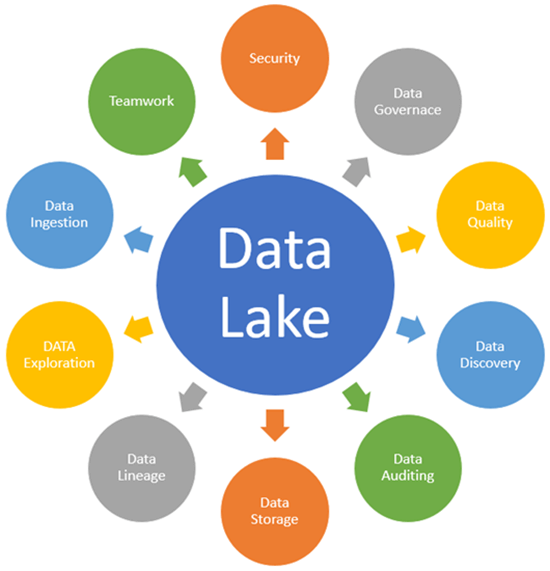
Building a data lake is not just about dumping data into a cloud bucket. A well-designed data lake architecture ensures usability, performance, and governance. Key components include:
-
Data Ingestion Layer
-
Captures data from multiple sources (batch, streaming, real-time).
-
Tools: Apache Kafka, AWS Kinesis, Azure Event Hubs.
-
-
Storage Layer
-
Centralized repository for raw and curated data.
-
Cloud options: Amazon S3, Azure Data Lake Storage, Google Cloud Storage.
-
-
Processing Layer
-
Prepares data for analysis via ETL (Extract, Transform, Load) or ELT (Extract, Load, Transform).
-
Tools: Apache Spark, Databricks, AWS Glue.
-
-
Metadata and Catalog Layer
-
Helps users discover and understand data assets.
-
Tools: AWS Glue Data Catalog, Apache Atlas, Azure Purview.
-
-
Security and Governance Layer
-
Ensures access control, data lineage, compliance, and auditability.
-
Integration with IAM, encryption, and monitoring tools.
-
-
Consumption Layer
-
Interfaces for BI, analytics, and machine learning.
-
Tools: Tableau, Power BI, Jupyter Notebooks, SageMaker.
-
Common Use Cases of Data Lakes
-
Customer Analytics
-
Retailers analyze purchase history, browsing patterns, and social media interactions to personalize offers.
-
-
IoT and Predictive Maintenance
-
Manufacturers use sensor data stored in data lakes to predict equipment failures and optimize maintenance schedules.
-
-
Fraud Detection
-
Financial institutions detect fraudulent transactions by analyzing patterns in massive, diverse datasets.
-
-
Healthcare Insights
-
Hospitals integrate medical imaging, patient records, and sensor data for advanced diagnostics.
-
-
Real-Time Supply Chain Optimization
-
Logistics companies leverage data lakes for tracking shipments, predicting delays, and optimizing routes.
-
Challenges of Data Lakes
While data lakes offer immense potential, they also bring challenges:
-
Data Swamps
Without governance, a data lake can quickly turn into a “data swamp”—a messy, unusable pile of raw data. -
Security Risks
Large volumes of sensitive data require stringent access controls and encryption. -
Data Quality Issues
Since raw data is ingested, poor-quality data can impact downstream analytics unless properly cleansed. -
Complexity in Management
Large-scale data lakes involve complex architectures and require skilled talent for setup and maintenance.
Best Practices for Implementing a Data Lake
-
Start Small, Scale Fast
Begin with a specific use case (like customer analytics) before expanding to enterprise-wide adoption. -
Invest in Metadata and Cataloging
Without proper cataloging, users won’t be able to find or trust the data. -
Implement Strong Governance
Define policies for data access, security, compliance, and lifecycle management from the start. -
Adopt Cloud-Native Services
Cloud data lakes provide elasticity, scalability, and integration with advanced analytics tools. -
Empower Self-Service Analytics
Democratize access so business users, not just data scientists, can extract insights.
Data Lake Governance and Security
Governance is the difference between a data lake that delivers business value and one that becomes a liability. Key governance considerations include:
-
Identity and Access Management (IAM): Ensure role-based access control.
-
Data Lineage: Track how data flows and transforms across the ecosystem.
-
Data Quality Rules: Enforce validation at ingestion and transformation stages.
-
Compliance: Meet regulatory requirements like GDPR, HIPAA, or CCPA.
-
Encryption: Secure data both at rest and in transit.
The Future of Data Lakes: Lakehouses and Beyond
Data lakes are evolving. The rise of the Data Lakehouse—a hybrid architecture combining the flexibility of data lakes with the reliability and performance of warehouses—is transforming the landscape. Solutions like Databricks Delta Lake or Snowflake’s approach allow organizations to unify structured and unstructured data analytics seamlessly.
Other trends shaping the future include:
-
AI-Driven Data Governance: Automating cataloging, classification, and compliance monitoring.
-
Serverless Data Lakes: Reducing operational overhead with managed cloud services.
-
Integration with Edge Computing: Real-time ingestion and analysis from IoT devices.
-
Multi-Cloud Data Lakes: Avoiding vendor lock-in by distributing storage and analytics across platforms.
Business Value: From Data to Actionable Insights
Ultimately, a data lake is not about storage—it’s about unlocking insights. By breaking down silos, enabling innovation, and providing scalable infrastructure, data lakes empower organizations to:
-
Innovate faster.
-
Improve customer experiences.
-
Enhance operational efficiency.
-
Reduce costs.
-
Future-proof their data strategy.
Conclusion
A Data Lake is far more than a storage system—it’s a strategic asset for organizations aiming to thrive in the digital age. Done right, it becomes a foundation for analytics, AI, and business transformation. Done poorly, it risks becoming a swamp of untapped potential.
The difference lies in thoughtful architecture, governance, and alignment with business goals. Organizations that master data lakes will not only survive but excel in a future where data is the ultimate competitive advantage.